On a recent dog walk I noticed the Essex Skipper above struggling to get a grip on a grass stalk in the undergrowth. Made me think of athletes doing a workout on the bar, but more slapstick comedian than dainty little gymnast. In one of the shots it even looks as if he/she has deadpan eyebrows. These are unconventional little butterflies.
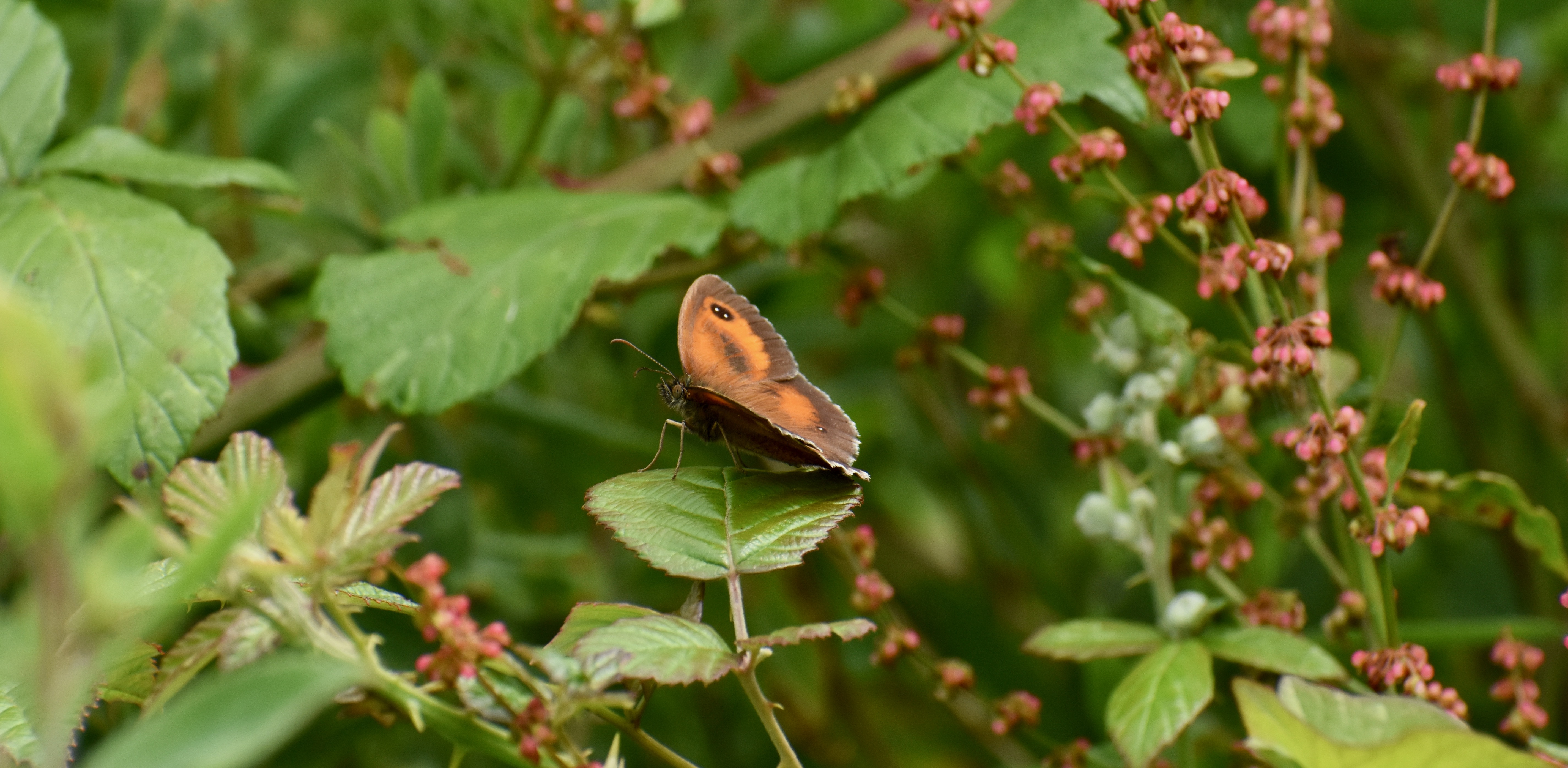
More conventional were the Gatekeepers I saw a couple of days ago on some bramble bushes – the first of the year for me. They have more varied markings than most butterflies, and some quite exotic – in a brown and orange sort of way.
Otherwise not many new arrivals around. The cloudy weather is probably not helping but it should get more lively within the next week or two. Didn’t see many Common Blues earlier in the year – just one in the field next to the house and not many up on the plain. It’ll be interesting to see how many we’ll get in the second generation. Sunny days forecast for next week so should find out soon.
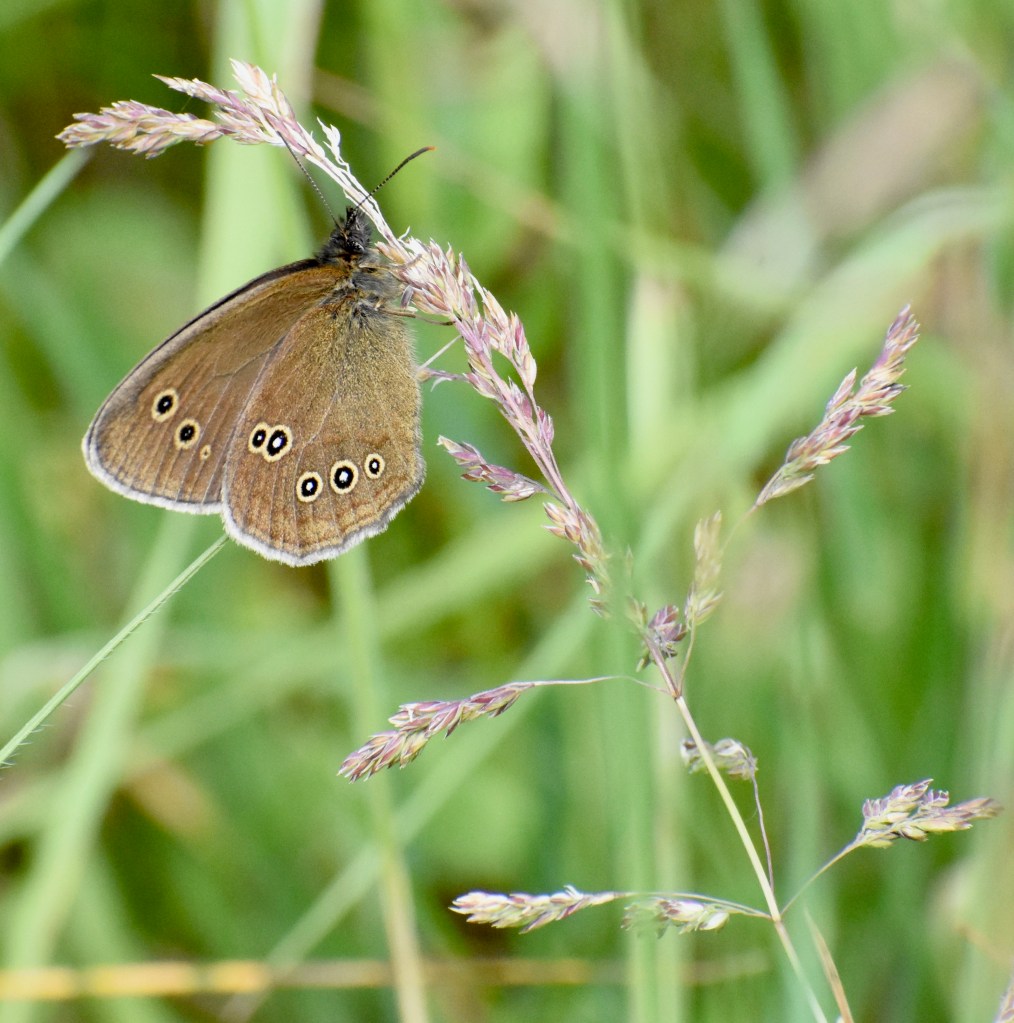
Was chatting to a knowledgable neighbour the other day about Ringlet butterflies, as you do, and he said that when you get your eye in you start to see them everywhere. The fact that we’re approaching peak Ringlet season helps too, but it’s also approaching peak Meadow Brown season, so the Ringlets can easily be lost in amongst the hoards of their more common brown cousins. So it definitely helps to have your eye in.
Ringlet in pristine condition
The best shot I managed of a recently emerged Ringlet with open wings showing off that dark velvety upper wing. They do a lot of flittering and not much landing. And even less resting with wings open.
I got my eye in the weekend before last. I’d read somewhere that Ringlets are unusual in that they often fly when it’s overcast. It was cloudy that day and the dogs needed walking so I decided to put the theory to the test. If the Meadow Browns weren’t flying and the Ringlets were, it would make it much easier to see and identify them. And that was how it turned out. I saw a couple of dozen Ringlets on the walk and managed to get pictures of a few. Pretty much the only Meadow Browns that were flying that day were the ones I’d disturbed while walking through long grass – along with the Marbled Whites and skippers that were also sheltering there. It was windy, and on the rare occasions the Ringlets landed it seemed always to be low down, sheltering in amongst the grass. Which made photographing them difficult. As you can see…
Once you’ve seen a few Ringlets, you notice that they have a faintly blue, misty tinge to their dark wings in flight – particularly newly emerged ones. And they seem to me to have a preference for longer grass, often not far from trees and scrub, whereas the Meadow Browns can be seen almost anywhere, from bramble bushes, which they sometimes congregate around in large numbers, to fluttering on their own across wide open grassland. Knowing where to look for Ringlets makes it easier to find them. Having said that I’m not sure I’d feel confident enough to put money on identifying one in flight. The picture below is of a male Meadow Brown I photographed in the garden which, before it landed, I’d convinced myself was a Ringlet.
And here’s a picture of a Ringlet that landed on the Michaelmas daisies by our back door and which I thought initially was probably another Meadow Brown.
Those upper wings, which are often most of what you see when they’re flying low to the ground, are still very similar to me. Maybe I need to get my eye in a little more.
Also flying in the field by our house at the moment, along with the whites and the browns, are skippers. Here’s a Small one who decided to rest its front legs for a bit.
And here’s an Essex Skipper, the first I’ve seen this year, that was chilling out on an Umbellifer bud on the overcast day mentioned earlier. With their antennae tips dipped-in-ink look, they’re one of my favourites.
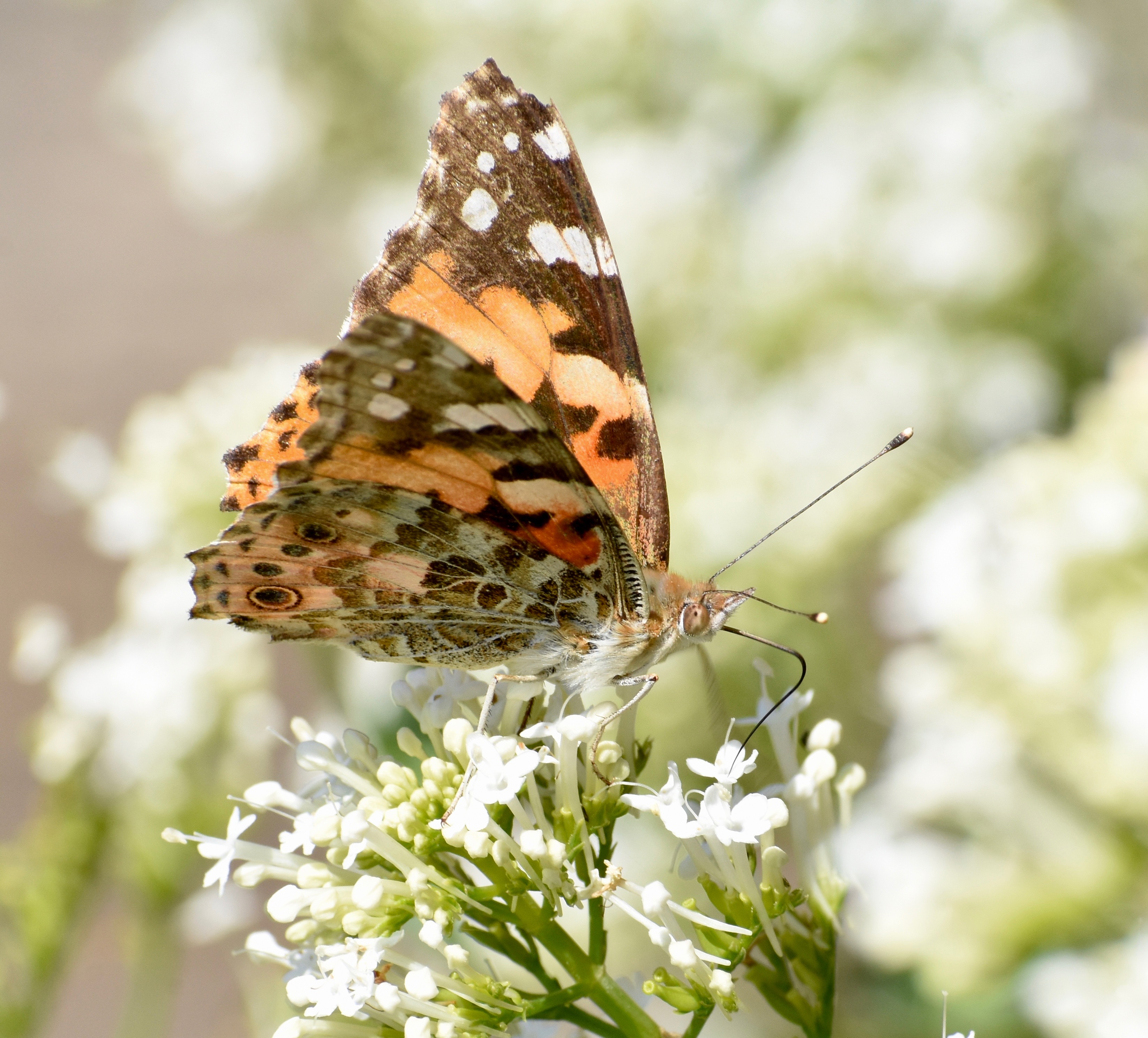
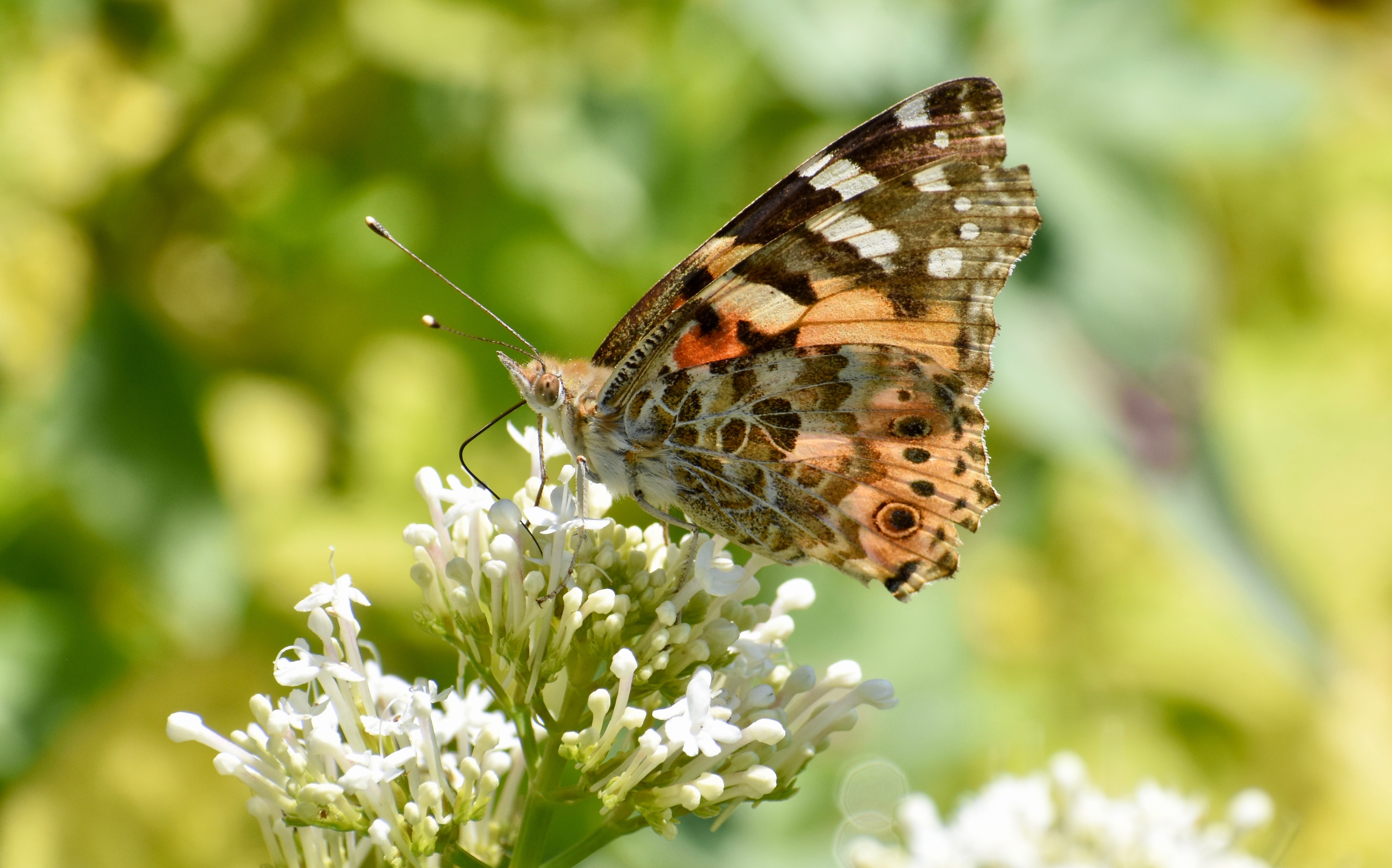
Our first Painted Lady arrived on June 14th, six days earlier than last year. No problems with travel restrictions when you’re a migrating butterfly – if the instinct for international travel grabs you, off you go.
Like last year, our early arrival was a little worn after its journey from Africa, and thirsty, and gorged itself on Valerian nectar for quite a while, proboscis probing one tiny flower after another. Which allowed me, like last year, to take too many pictures.
Once they’re revitalised with all that sugary fuel, they don’t hang around in one spot for long and they become a lot less tolerant of human beings with cameras. The newly hatched second brood in August-September time will be more brightly coloured and in pristine condition, but it’s still great to see these early arrivals again.
I also managed, on the same day, to take a couple of pictures of a Ringlet. I’d seen one a couple of days previously, but had only managed a smudged shot as the butterfly took off just as I pressed the shutter.
It flew off and disappeared over the horizon. Which was frustrating as I hadn’t managed to get a single shot of one last year.
I fancied another try and thought I might as well go to the same spot I’d seen the one a couple of days before. So that was where the dogs were walked. There were a few false alarms on the way: I saw what turned out to be (through the lens) a few male Meadow Browns that were all over some highly scented wild privet. But in the mile or so to the site, I didn’t see any Ringlets. When we got there I wasn’t too optimistic either. The one from a couple of days before had flown so far away, and so quickly, that it seemed as if it was just passing through rather than in its own territory.
But then there it was. Only a few yards from the previous sighting.
Simple colouring and markings, but a beautiful butterfly none the less, and with a lovely velvet finish to its wings – which probably isn’t apparent in the picture above.
As soon as I’d taken my shot, the butterfly was up and away again, and soon out of sight. And I didn’t see any others on the rest of the walk – as had happened previously.
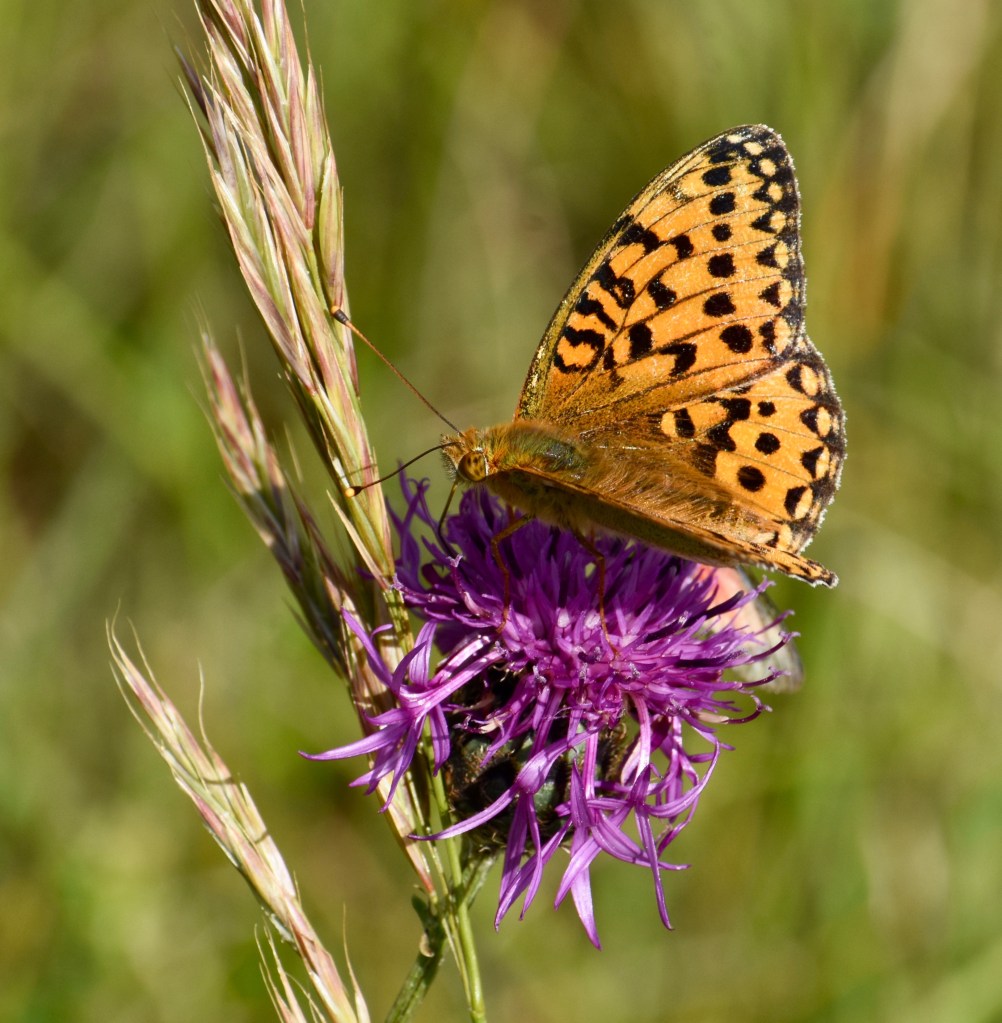
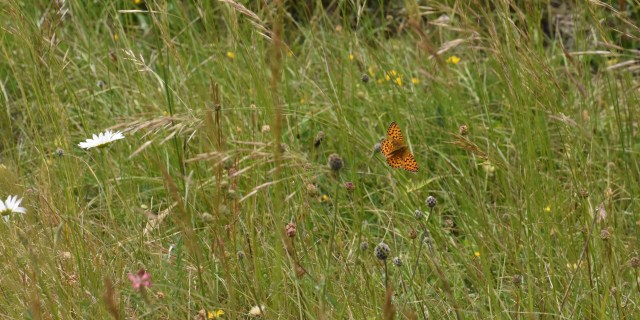
On our way back though, I did manage a shot of a Dark Green Fritillary that had landed – and stayed landed for more than a few seconds – on some Knapweed which is now beginning to come out everywhere.
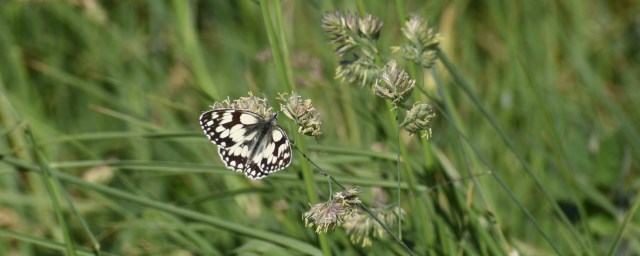
Butterflies love it, as can be seen with these four Marlbled Whites who lined up very neatly for the camera.
Sometimes butterflies just realise there’s a photo opportunity and produce the goods.
It’s been a bit of a quiet time in the garden for butterflies recently, but there’s been plenty of other activity: foxes, deer, stoats, and water shrews in the stream (though the site of the stoat swimming suggests water shrew life – if still present – is precarious). And we’ve seen plenty of insects other than butterflies – some visiting, some born and bred in the garden.
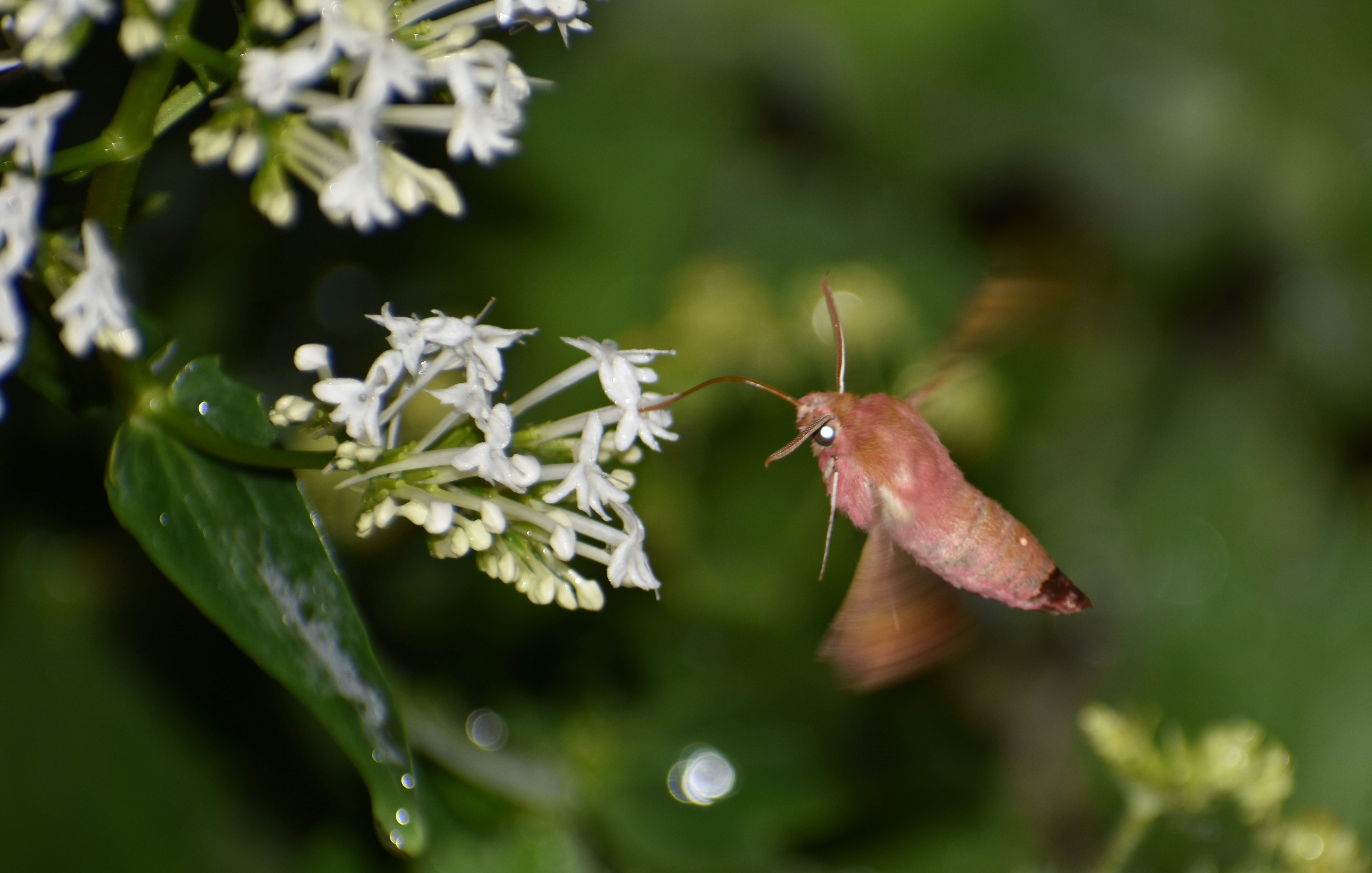
We were out checking for slugs on pot plants the other evening – around about 10:00 – when we noticed a swarm of Elephant Hawkmoths over the Valerian. They were illuminated in the light from the kitchen windows, and there seemed to be dozens of them. They are impressive insects, almost as good at hovering and probing the tiny flowers with their proboscises as the Hummingbird Hawkmoths that visit during the day. And bigger too, and in an unusual and striking shade of pink. Have seen them before in the garden but never in such numbers. And we see their caterpillars now and again, marching across the patio.
Elephant Hawkmoth Caterpillar, marching
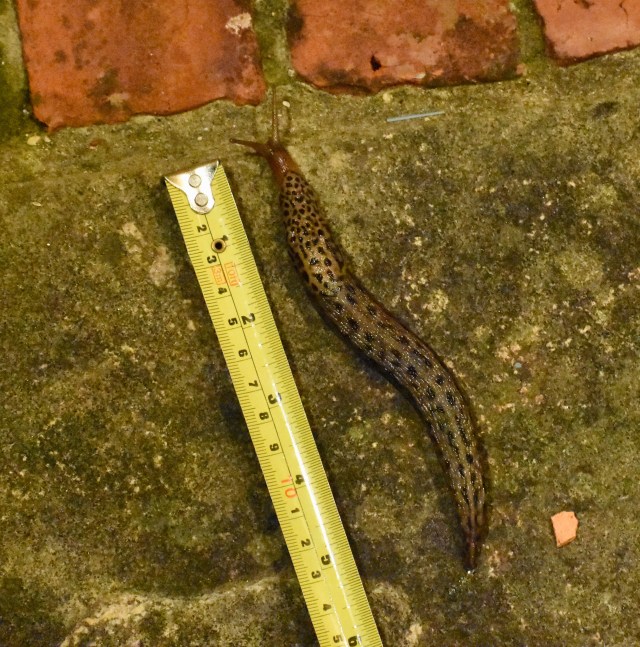
Apparently it gets its name from the way its caterpillar looks like an elephant trunk. Which it does, pretty much, apart from the cartoon-like false eyes on the front. And it’s big too. Not as big as the Leopard Slug I once saw outside the back door, but big – a good three inches. Here’s a picture of our enormous Leopard Slug from Aug 2018.
Our enormous Leopard Slug
It was quite a shock. I had no idea slugs ever got that big in this country. The Leopard Slug gets its name, not unreasonably, from the spots on its back. The smaller slugs found on our pot plants get thrown into the field on the other side of the stream, but not this big fella. We learned they eat other slugs so he stayed where he was. He revisited the following evening but sadly we didn’t see him again after that and haven’t seen any others anything like that length since. We get quite a few badgers passing through and I’m guessing a six inch slug would have been quite a tempting snack for one of them. I think if a toad had had a go, it might have fought back.
Back to the Elephant Hawkmoths. I went out to see if I could get a picture of them the night before last, but after all the rain we’d had, and with the lower temperatures, there were far fewer about. Maybe three or four at any one time. I’d noticed, on the warm night when we’d seen so many, that they didn’t seem to like the light from the torch, but I thought that if I used the camera flash the shot would be in the can before they dispersed. I’d forgotten that the camera uses a light beam – in low light – to get the autofocus to work before the flash picture is taken, and the focusing light beam seemed to scare the moths away before that was possible. Which was frustrating. Having said that, I think I might have read somewhere that they are attracted to light so maybe it’s just that I was too close for their comfort when moving in for the shot. Anyway, there were one or two that seemed less sensitive than others and I did get some reasonably crisp shots that show off their hovering skills.
Elephant Hawmoths, hovering
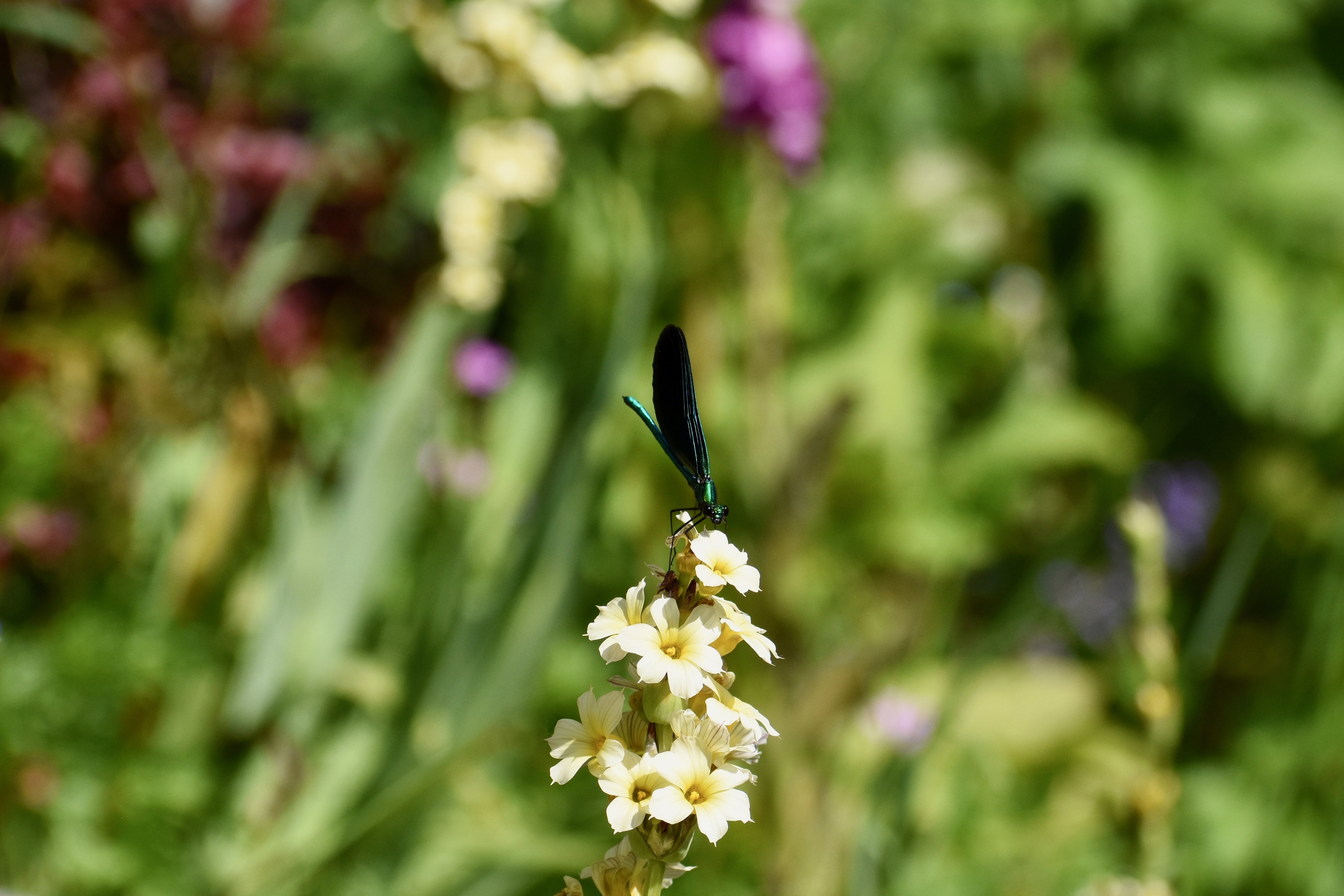
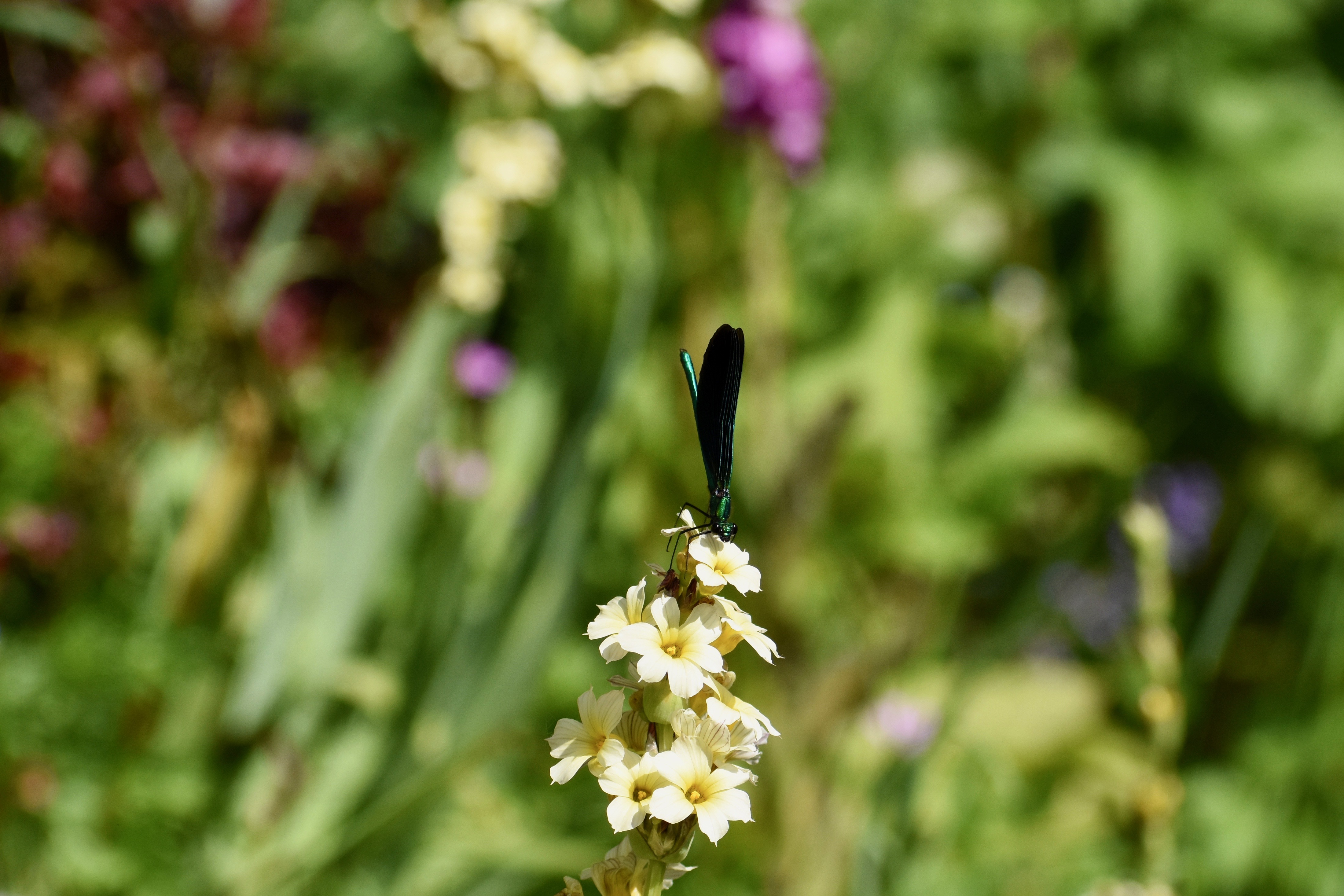
Other insects seen in the garden recently include three species of Damselflies: the Banded Demoiselle, the Large Red Damsel and the Beautiful Demeoiselle.
I was initially confused over the identification of the ‘Beautiful Demoiselles’ as I hadn’t realised that the males start off their adult lives with brown wings and finish them with bright blue ones, once they’ve matured. Now I know who’s who, it looks like the Beautiful Demoiselles have taken up the majority of territories along our length of stream. The Banded Demoiselles we see seem to be passing through and haven’t settled – at least not when I’ve had a camera to hand. And the same goes for the darters and Emperor Dragonflies that we’ve occasionally seen.
Here’s a small red damselfly which I identified from the book as a Large Red Damselfly (the small ones must be tiny).
Spent some time watching a mature male Beautiful Demoiselle who was doing some hunting of tiny insects that I could hardly see. I noticed he was using the same perch between sorties, so I thought I’d try freeze-framing him with a fast shutter speed as he came back in to land (there was no chance my reactions would be quick enough to get him taking off). His sorties were pretty quick, so I thought that if I kept taking pictures at five frames a second (or whatever it is) after I’d registered him taking off while keeping the focus on the flower head, there was a decent chance I’d get some sharp pictures of him coming back in to land.
Here’s the resulting slideshow: coming into land; undercarriage out; touch-down; fold back wings; manoeuvre into alert position for next take off.
Haven’t managed any pictures of dragonflies in the garden, but took a few at a near-by lake. Here’s one of what I think is a Four-Spotted Libellula. Have been surprised, since I first became interested in close up photography, how hairy some insects, especially butterflies, are. But the hairiness of this darter dragonfly – which they don’t show in the books – was was even more unexpected. And very different from the metallic, tubular bodies of Damselflies and some of the Hawker Dragonflies.
Wonder how it affects their aerodynamics. Maybe it gives them more traction in the air, allowing them to stop and change direction more quickly, darting this way and that – as their name describes.
We were out walking the dogs yesterday on the plain, when I started seeing a few large orange butterflies zooming about this way and that. I thought they’d be Dark Green Fritillaries, which I’d seen not far away in previous years, and I thought I’d try getting a picture to confirm it.
They were not being cooperative.
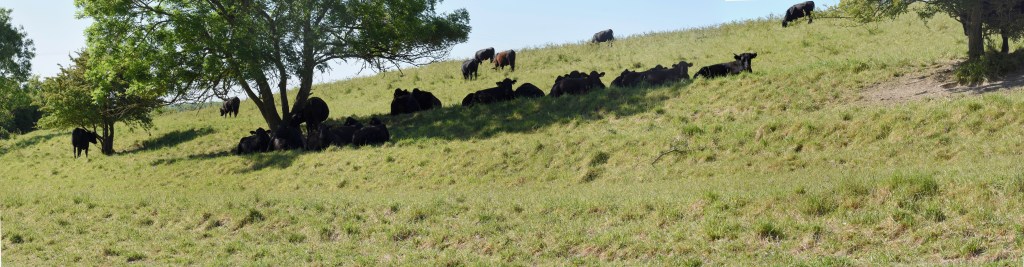
Dark Green Fritillaries are large butterflies and strong fliers, and they were going at quite a lick across the downland in search of whatever it was they were in search of. When they did land, it was always a distance away and even though there were not that many butterflies about, another fritillary always seemed to appear and fly past just before I got there, tempting the first one to take off and follow. Very frustrating. You have to move pretty quickly to keep up with them, and it was a bit windy too, which seemed to make everything speed up a little more. And then there was the issue that if you’re going to follow their erratic flight, you have to keep watching the butterfly ahead of you – at least some of the time – rather than where you’re putting your feet. With grazing cattle having been there through the wet winter, the ground was uneven underfoot, to put it mildly, on the really quite steep escarpment slope where the butterflies had been steadily leading me.
I decided that if I was going to avoid injury, it might be an idea to try to get a shot of the butterfly in flight rather than continue charging about this way and that, up and down the escarpment like a lunatic. As my wife put it.
I increased the shutter speed, opened the aperture a bit, zoomed out to give myself a better chance of catching the butterfly in frame, and went for it.
Named ‘Dark Green’ after the colouring on the underwing
I managed to get a couple of shots fairly quickly which were sharp enough to confirm that they were indeed Dark Green Fritillaries, this one recently emerged and in beautiful condition. And good to see it in the midst of its natural habitat too.
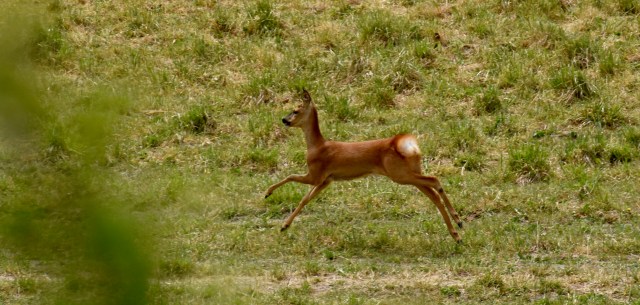
Job done, I put my camera settings back to those suited to stationary subjects. And that was the point at which a fast moving subject in the form of a sprightly Roe Deer at the bottom of the escarpment, appeared. It looked amazingly elegant as it ran along. There was no time to change the setting again, so I took a couple of shots – with nothing to lose – and the pictures, though not pin sharp, didn’t turn out too badly.
At 1/400 and at 300mm her movement was surprisingly well frozen, I thought. The young Roe deer was in great condition too which is always lovely to see. Many of the deer we get in the field next to our garden look as if they’ve had a pretty tough time of it, sometimes with scars all over their bodies.
This one was a beauty. It’s a delight to see creatures in peak condition before the rough and tumble of life has taken too much of its toll. Whether butterflies or deer.
Turns out our mystery plant in the Bay Tree pot was a Common Spotted Orchid – a couple of them, side by side.
In retrospect, it was the most likely outcome: they’re the most common species of orchid in the UK, they like a variety of habitats, and the leaves of the plant in our pot were, well, spotted. The white of the buds made us initially unsure but they became more of a delicate pink as they opened.
Two Common Spotted Orchids that decided to set up shop in our garden.
They have started to appear in numbers up on the plain now as well – no surprises there. So too, the Pyramid Orchids – as astonishingly pink as ever. Saw the first Marbled White of the year this morning as well. Summer’s here!
Managed one shot before he flew up and a gust of wind took him over the hawthorns and far away. No others seen.
Also spotted one or two Meadow Browns – first I’ve seen on the plain this year – and some Large Skippers (picture of one below).
Have been seeing Small Heaths for about a month now and there are still plenty about. It’s been a good year for them. A little surprising to me that they have a high priority conservation status as we see them pretty much along all the paths we walk the dogs. They’re not confined to one or two sites like other uncommon butterflies on the plain. And we’ve had a few in the garden as well. They must just like it round here.
Recent Garden Arrivals
Small Heath deep into Geranium Flower 29.5.20
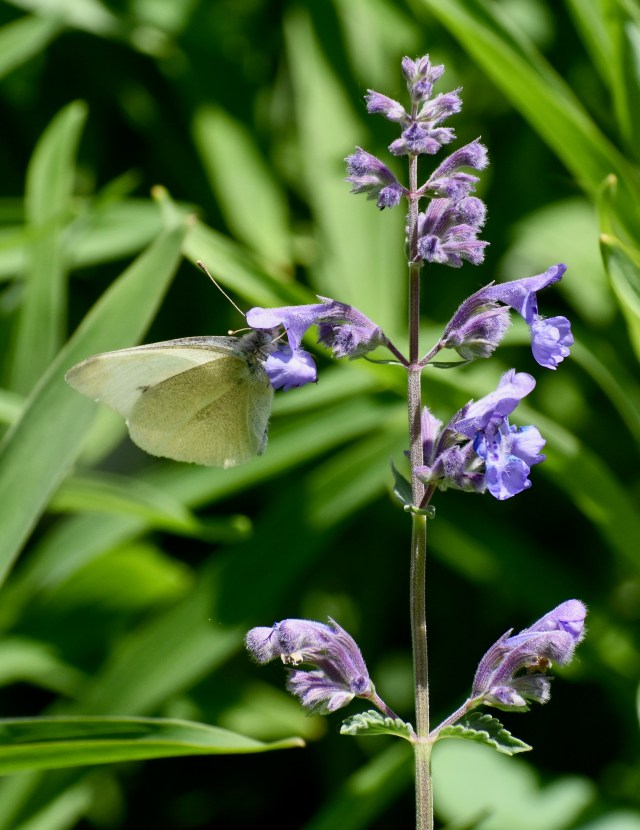
Second Brood Tortoiseshell on Catnip 31.5.20
Meadow Brown sipping morning dew on grass 30.5.20
Large Skipper on stream-side Irises 25.5.20
First Small White, gorging Catnip nectar, Antennae bent back with the effort 28.5.20
Great dog-walking weather this morning: bright blue skies and a cooling breeze. Still a bit warm for some inhabitants of the plain though.
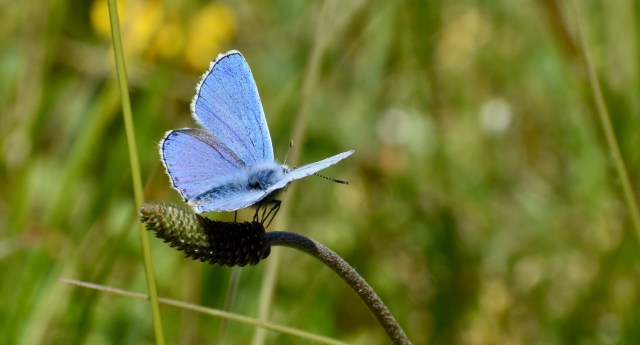
Looks like the Adonis Blues took a bit of a hammering in the high winds we had recently. I was at our local Site of Special Scientific Interest yesterday and there were, as I’d heard, numerous Adonis Blues on the wing.
I took a few pictures but came across none that were in really mint condition. The wing edges of even the shiny, fresh ones looked frayed. No surprises really as winds here gusted to 40 MPH for a couple of days. In the sheltered valley where we live, the blustery wind managed to break a substantial branch – ten or twelve foot long – off a willow tree next to our garage. The wind must have been quite violent on the exposed downland.
Edges frayed so that the usual checkered fringe is no longer visible. Lovely pale blue fur though.
But of course the animals and plants that live there have adapted to the conditions. I noticed this time that the Buttercups on the site really do hug the ground – just a couple of inches or so off it – whereas in the field next to us, in the valley, there are Buttercup plants two to three foot tall. Don’t know if they’re the same or similar species (must check it out), but they have very different dimensions. Of course, individual plants adapt to the particular environment in which they find themselves. Plants that are cropped by grazing animals (or lawn mowers) produce shorter flowering stalks at their next attempt – but I wonder whether there is also some local selective pressure that favours the genes of plants with shorter flower stems. A question of balancing the advantages of attracting pollinators with higher more visible flowers against the likelihood of being snapped off in a strong wind – a kind of evolutionary Tall Poppy Syndrome.
There’s another aspect of flower heights that occurred to me, which is probably not quite as academic as questions of Survival of the Fittest. It’s to do with how accurately photographers represent their subjects’ environment.
At this time of year, during their first emergence, Adonis Blues spend much of their time sipping the nectar of the Horseshoe Vetch (which is their caterpillar food plant and which, not surprisingly, there are plenty of where you find the Adonis). They seem to me to spend more time on these bright yellow flowers, which grow close the ground, than on any other. The problem for the photographer is that when the flower they’re attracted to most is so close to the ground, it’s difficult to achieve a nicely thrown-out-of-focus background. And their being in amongst the matt of ground foliage, you often get other plants obscuring your view and throwing shadows on to your subject. As a result you tend to spend most of your time looking, and waiting, for butterflies that have perched on something taller – grass seed heads, or taller flowers.
Adonis on Sanfoin
Adonises on Daisy
Adonis on Horseshoe Vetch
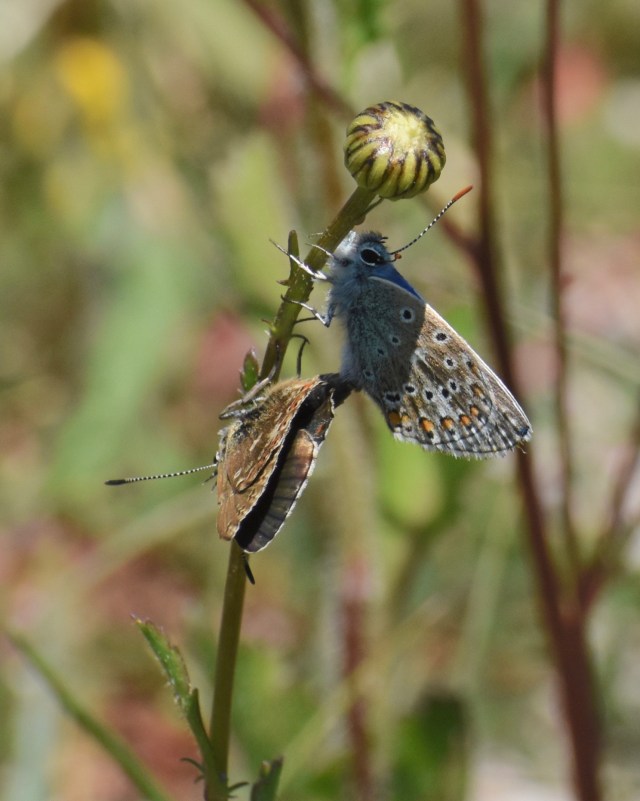
You can see that the image on the right with the Adonis perched on a Horseshoe Vetch flower is a bit muddled with the in-focus grass stems all around, one of which is casting a shadow over the butterfly itself. Not ideal. But perhaps it’s a truer image of the butterfly in its habitat than the one at the top of the blog which is a better picture. There is also a heavy shadow on the central image of a mating pair, which isn’t great either, but I’ve included it here because you can see how vividly orange the underside of their antennae tips are – it came as a surprise to me.
Does it matter that the pictures you end up with are not particular representative of the butterfly’s habits and habitat or their flower nectar preferences? Not sure. Probably not. But that was certainly the case for the selection I took yesterday. Aesthetic considerations distorting reality? Nothing particularly new there: don’t let facts get in the way of a good story; don’t let Nature get in the way of a good image.
Battered male Adonis, perched on a grass seed head
In the above image of an Adonis on a grass seed head, we can see evidence of all the Horseshoe Vetch plants in the background – maybe the best of both worlds.




















 Learning about Photography, Butterflies and the White Rainbow